Tradition: Tibetan Buddhism
Buddhist Lineage: Shakyamuni, Kadampa, Gelug (Yellow Hat School)
- Dalai Lama is a title given by the Tibetan people to the foremost spiritual leader of the Gelug or “Yellow Hat” school of Tibetan Buddhism, the newest and most dominant of the four major schools of Tibetan Buddhism. Until 1959 the Dalai Lama was both spiritual and temporal ruler of Tibet.
- There are four schools of Tibetan Buddhism; Nyingma (founded in 8th century); Kagyu (founded in the early 11th century); Sakya (founded in 1073); Gelug (founded in 1409)
The Gelug school is the newest and largest school of Tibetan Buddhism. Founded by Tsongkhapa Lobzang Drakpa Je Tsongkhapa (1357–1419), who was one of the period’s foremost authorities of Tibetan Buddhism who studied under Sakya, Kagyu, and Nyingma masters. It continues the distinctive traditions of the Kadampa school of the great Indian master Atisha (982-1054).
Kadampa school is a special tradition of Buddhism founded by the Atisha (AD 982–1054), an Indian Buddhist Master who revolutionized the way people practiced Buddhism in both India and Tibet in the 11th century. The school teaches Vajrayana Buddhism including tantric practices.
Vajrayana Buddhism originated in northern India around the 5th century in northern India and took root in Tibet in the 7th and 8th centuries. Vajrayāna practices are connected to specific lineages in Buddhism, through the teachings of lineage holders.
The main features of Vajrayana are:
- The use of mantras, a form of chanting.
- Strong focus on the guru, or teacher.
- The importance of meditation, including concentration techniques such as the visualization of bodhisattvas.
Tibetan Buddhism also includes tantric practices, such as deity yoga and the Six Dharmas of Naropa, as well as methods that are seen as transcending tantra, like Dzogchen
The Gelug school focuses on ethics and monastic discipline and the need to pursue spiritual practice in a graded, sequential manner. Gelug is the only school of vajrayāna Buddhism that prescribes monastic ordination as a necessary qualification and basis in its teachers.Lay people are usually not permitted to give initiations if there are teachers with monastic vows within close proximity.
About the 14th Dalai Lama
Lhamo Thondupwas born on 6 July 1935 to a farming and horse trading family in the small hamlet of Taktser,or Chija Tagtser,at the edge of the traditional Tibetan region of Amdo in Qinghai, Republic of China.
He was one of seven siblings to survive childhood and one of three recognised reincarnated Rinpoches in the same family.
In Tibetan Buddhism rebirth is an involuntary process which is due to one’s karma. Reincarnation on the other hand, is a voluntary process, not dependent on Karma. The Tulku (or emanation of the buddha body) chooses to be born again. The Tulku will consciously determine where and when to reincarnate in order to continue their Bodhisattva vow.
In 1937 Lhamo Thondupwas was selected as the Tulku of the 13th Dalai Lama when he was two years old.
in 1939, at the age of four, he was taken in a procession of lamas to Lhasa. The traditional ceremony enthroning the 14th Dalai Lama
His enthronement ceremony was held in Lhasa on 22 February 1940 and he eventually assumed full temporal (political) duties on 17 November 1950, at the age of 15.
1954-1955, the nineteen year old Dalai Lama toured China for almost a year, meeting many of the revolutionary leaders including the Chinese communist leadership who created modern China. He learned Chinese and socialist ideals.
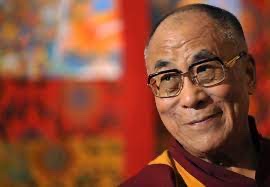
In 1956, on a trip to India to celebrate the Buddha’s Birthday, the Dalai Lama asked the Prime Minister of India, Jawaharlal Nehru, if he would allow him political asylum should he choose to stay.
In 1959, at the age of 23, the Dalai Lama took his final examination at Lhasa’s Jokhang Temple. He passed with honours and was awarded the Lharampa degree, the highest-level geshe degree, roughly equivalent to a doctorate in Buddhist philosophy
The 1959 Tibetan uprising began on 10 March 1959, when a revolt erupted in Lhasa (the capital of Tibet) which had been under control of the People’s Republic of China since 1951. Fearing for his life, the Dalai Lama and his retinue fled Tibet with the help of the CIA’s Special Activities Division, crossing into India on 30 March 1959.
On 29 April 1959, the Dalai Lama established the independent Tibetan government in exile in Mussoorie, which then moved in May 1960 to Dharamshala, where he now resides.
The Dalia Lama retired as political head of Tibet in 2011 to make way for a democratic government, the Central Tibetan Administration.
The Dalai Lama advocates for the welfare of Tibetans and since the early 1970s has called for the Middle Way Approach with China to peacefully resolve the issue of Tibet. He travels worldwide to give Tibetan Mahayana and Vajrayana Buddhism teachings.
He has over 18 million followers on Twitter and 14 million followers on Facebook.
The Dalai Lama’s best known teaching subject is the Kalachakra tantra which, as of 2017, he had conferred a total of 34 times,most often in India’s upper Himalayan regions. The Kalachakra (Wheel of Time) is one of the most complex teachings of Buddhism, sometimes taking two weeks to confer, and he often confers it on very large audiences, up to 200,000 students and disciples at a time.
He also attends conferences on a wide range of subjects, including the relationship between religion and science, meets with other world leaders, religious leaders, philosophers and scientists, online and in person.
The Dalai Lama is the author of numerous books on Buddhism, many of them on general Buddhist subjects but also including books on particular topics like Dzogchen, a Nyingma practice.
The Dalai Lama has said “When I am about ninety I will consult the high Lamas of the Tibetan Buddhist traditions, the Tibetan public, and other concerned people who follow Tibetan Buddhism, and re-evaluate whether the institution of the Dalai Lama should continue or not”.
The Dalai Lama uses various meditation techniques, including analytic meditation and emptiness meditation.
The aim of meditation is to maintain a very full state of alertness and mindfulness, and then try to see the natural state of your consciousness. All human beings have an innate desire to overcome suffering, to find happiness. Training the mind to think differently, through meditation, is one important way to avoid suffering and be happy.
Dalai Lama
LINKS
Dalai Lama website HERE, Twitter, Facebook, Instagram
The Dalai Lama Center HERE
The Dalai Lama Centre for Compassion HERE
Mind & Life Institute HERE
Foundation for Universal Responsibility HERE



 Cosmic Consciousness
Leave a comment