Who couldn’t be interested about the life and work or Nikola Tesla? He read voraciously and is reported to have had an eidetic memory, going beyond the visual recall of a photographic memory.
He is said to have envisioned complete diagrams of inventions, sometimes working only from memory, not bothering to draw them. He spoke seven languages. Like many great scientific minds, he required little sleep, and is reported once to have worked 84 hours straight without stopping to eat or rest.
Personally, I like obsessive, quirky types and definitely fall into a category of sapiosexuality.
A bit of background
Nikola Tesla (10 July 1856 – 7 January 1943, aged 86 years) was an ethnic Serb, born in the village of Smiljan present day Croatia. His father, Milutin Tesla (1819–1879), was a priest of the Eastern Orthodox Church.
Tesla’s mother, Đuka Mandić (1822–1892 and whose father was also an Eastern Orthodox Church Priest), had a talent for making home craft tools and mechanical appliances and the ability to memorise epic poems.
By the age of 19, Tesla was studying electrical engineering at the Polytechnic Institute at Graz in Austria, where he quickly established himself as a star student. He found himself in an ongoing debate with a professor over perceived design flaws in the direct-current (DC) motors that were being demonstrated in class, he left in his third year without receiving a degree.
He spent the next six years of his life “thinking” about electromagnetic fields and a hypothetical motor powered by alternate-current that would and should work. The thoughts obsessed him, and he was unable to focus on his schoolwork. Tesla became a gambling addict, lost all his tuition money, dropped out of school and suffered a nervous breakdown.
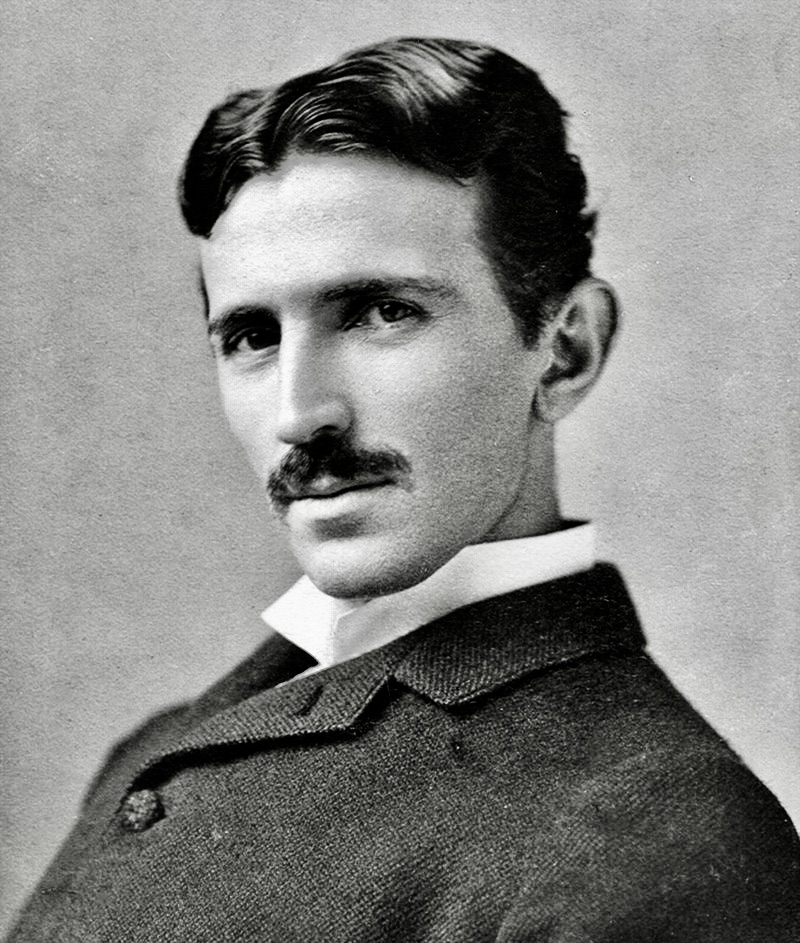
In 1881, after recovering from this breakdown, Tesla moved to Budapest. As he was walking through a park with a friend, reciting poetry, a vision came to him. There in the park, with a stick, Tesla drew a crude diagram in the dirt — a motor using the principle of rotating magnetic fields created by two or more alternating currents.
While AC electrification had been employed before, there was no practical, working motor run on alternating current until he invented his induction motor several years later.
In June 1884, Tesla sailed for New York City and arrived with four cents in his pocket and a letter of recommendation from Charles Batchelor, a former employer to Thomas Edison.
According to Tesla, Edison hired him and offered him $50,000 if he could improve upon the DC generation plants Edison favoured. Within a few months, Tesla informed Edison that he had indeed improved upon his motors. Edison, Tesla noted in his autobiography, refused to pay up.
Tesla quit and took a job digging ditches. But it wasn’t long before word got out that Tesla’s AC motor was worth investing in, and the Western Union Company put Tesla to work in a lab, where he designed AC power systems that are still used around the world.
“The motors I built there were exactly as I imagined them. I made no attempt to improve the design, but merely reproduced the pictures as they appeared to my vision, and the operation was always as I expected.”
Nikola Tesla
Winning The Electrical Wars
Tesla left Edison’s company in 1884 at age 28 and in March 1885 he applied for his first patent on the improvement of arc lamp regulator.
He met backers who agreed to finance an arc lighting manufacturing and utility company in Tesla’s name, the Tesla Electric Light and Manufacturing Company.
In 1887, Tesla developed an induction motor that ran on alternating current (AC). His partners negotiated a licensing deal with George Westinghouse, whose licensing of the patent in 1888, came at the time of extreme competition between electric companies. The three big firms, Westinghouse, Edison, and Thomas-Houston Electric Company were financially undercutting each other, creating what became known as the “war of currents” between Edison’s and Thomas-Houston Electric’s DC driven system and Westinghouse’s alternating current system.
By 1890 the financial crash and subsequent banking issues led to the 1892 merger and patent sharing agreement between General Electrics (the Edison and Thomas-Houston merger) and Westinghouse.
The money Tesla made from licensing his AC patents made him independently wealthy and gave him the time and funds to pursue his own interests.
When Tesla was 38 years old, he met Swami Vivekananda
It’s interesting to note that Tesla used ancient Sanskrit terminology in his descriptions of natural phenomena. As early as 1891, he described the universe as a kinetic system filled with energy which could be harnessed at any location. His concepts during the following years were greatly influenced by the teachings of Swami Vivekananda.
The Vedas are a large body of texts originating in ancient India and are composed in Sanskrit and are the oldest scriptures of Hinduism. The nature of matter, antimatter, and the make up of atomic structure are described in the Vedas.
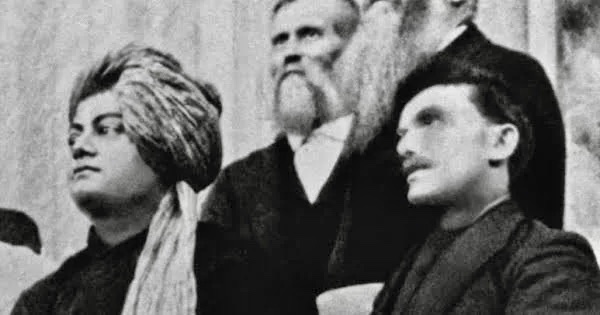
Swami Vivekananda was born in Calcutta, India in 1863. In 1893 (aged 30) he began a tour of the west by attending the Parliament of Religions held in Chicago. During the three years that he toured the United States and Europe, Vivekananda met with many of the well known scientists of the time including Nikola Tesla.
Swami Vivekananda was the first of a succession of eastern yogi’s who brought Vedic philosophy and religion to the west. After meeting the Swami and after continued study of the Eastern view of the mechanisms driving the material world, Tesla began using the Sanskrit words Akasha, Prana, and the concept of a luminiferous ether to describe the source, existence and construction of matter.
“Mr. Tesla thinks he can demonstrate mathematically that force and matter are reducible to potential energy. I am to go and see him next week to get this new mathematical demonstration. In that case the Vedantic cosmoloqy will be placed on the surest of foundations. I am working a good deal now upon the cosmology and eschatology of the Vedanta. I clearly see their perfect union with modern science, and the elucidation of the one will be followed by that of the other.”
extract from a letter by Swami Vivekananda
After the Electrical Wars
Having successfully completed his work on the AC motor, Tesla switched his focus to the field of wireless communication and energy transmission. At this time, messages could only be transmitted through wires – that is, using telegraphy.
But by the end of the 19th century he had built the foundation for modern-day telecommunications.
Wireless Lighting. In the summer of 1889 at age 33, Tesla invented the Tesla Coil and during an 1891 lecture at Columbia College, demonstrated wireless lighting. He did this by “electrostatic induction” when he held two Geissler tubes (similar to neon tubes) in his hands.
Wireless Electricity. In 1893 at a number of venues including the Franklin Institute and National Electric Light Association that he was sure a system like his could eventually conduct “intelligible signals or perhaps even power to any distance without the use of wires” by conducting it through the Earth.
In the early morning hours of 13 March 1895, the New York building that housed Tesla’s lab caught fire. It destroyed the building, a collection of early notes and research material, models, and demonstration pieces.
X-Rays. Tesla started again creating another New York lab. In 1894, he began investigating what he referred to as radiant energy of “invisible” kinds. Tesla may have inadvertently captured an X-ray image using Crookes tubes — predating, by a few weeks, Wilhelm Röntgen’s December 1895 announcement of the discovery using Geissler tubes.
Tesla devised experiments with X-rays, noting on the early investigation of this phenomenon some skin damage. On 11 July 1934, the New York Herald Tribune published an article on Tesla, regarding an experiment with his single-electrode vacuum tubes. Tesla described how a minute particle would break off the cathode, pass out of the tube, and physically strike him. He said he could feel a sharp stinging pain where it entered his body, and again at the place where it passed out.
Robots. In 1898, Tesla demonstrated a radio-controlled boat (describing his invention as tele-automatics) which he hoped to sell as a guided torpedo, he tried to sell his idea to the US military as a type of radio-controlled torpedo, but they showed little interest.
Wireless Electrical Power. During 1899 Tesla set up a lab in Colorado Springs. He conducted experiments with a large coil operating in the megavolts range, producing artificial lightning (and thunder) consisting of millions of volts and discharges of up to 135 feet (41 m) in length.
He aimed to develop experiments with high frequency electricity and other phenomena and research into wireless transmission of electrical power.
Tesla was experimenting with incredible electrical displays to measure and to analyse the results and electrical vibrations of earth.
The inventor designed an oscillator many times more powerful than he had worked in the past, to determine if it was possible to produce an effect which would influence the earth’s resonance.
Wireless Transmissions. In 1901 Tesla started work on a facility called Wardenclyffe on Long Island where he hoped to demonstrate wireless transmission of electrical energy across the Atlantic. Marconi defeated Tesla in the race to be first to complete such a transmission.
Whilst Guglielmo Marconi is popularly credited with inventing the radio, Tesla’s work was instrumental in its development. In fact, the Supreme Court overturned Marconi’s patent in 1943, crediting Tesla with being the first to patent radio technology.
Tesla attempted to secure financial backing for an even larger plan at Wardenclyffe where he planned to transmit messages and power by controlling “vibrations throughout the globe”. The project came to a halt in 1905, he lost the property in foreclosure in 1915 after which it was demolished.
Bladeless Turbine. On his 50th birthday, in 1906, Tesla demonstrated a 200 horsepower (150 kilowatts) 16,000 rpm bladeless turbine. Tesla licenced the idea to a precision instrument company and it found use in the form of luxury car speedometers and other instruments.
Room Sanitiser. Tesla attempted to market several devices based on the production of ozone. These included his Tesla Ozone Company selling an 1896 patented device (in 1900) based on his Tesla coil, used to bubble ozone through different types of oils to make a therapeutic gel.He also tried to develop a variation of this a few years later as a room sanitiser for hospitals.
Electricity for Intelligence. Tesla theorized that the application of electricity to the brain enhanced intelligence. In 1912, he crafted “a plan to make dull students bright by saturating them unconsciously with electricity,” wiring the walls of a schoolroom and saturating the schoolroom with infinitesimal electric waves vibrating at high frequency. Tesla claims that he whole room would be converted into a health-giving and stimulating electromagnetic field or ‘bath. The plan was, at least provisionally, approved by then superintendent of New York City schools, William H. Maxwell.
Radar. In the August 1917 edition of the magazine Electrical Experimenter, Tesla postulated that electricity could be used to locate submarines via using the reflection of an “electric ray” of “tremendous frequency, with the signal being viewed on a fluorescent screen. Émile Girardeau, who helped develop France’s first radar system in the 1930s, noted in 1953 that Tesla’s general speculation that a very strong high-frequency signal would be needed was correct.
Helicopter. In 1928, Tesla received patent, U.S. patent 1,655,114, for a biplane design he described as a helicopterplane capable of vertical take-off and landing (VTOL), which “gradually tilted through manipulation of the elevator devices” in flight until it was flying like a conventional plane.
A New Form of Energy. In 1933, at age 77, Tesla told reporters at his birthday event that, after 35 years of work, he was on the verge of producing proof of a new form of energy. He claimed it was a theory of energy that was “violently opposed” to Einsteinian physics and could be tapped with an apparatus that would be cheap to run and last 500 years. He also told reporters he was working on a way to transmit individualized private radio wavelengths, working on breakthroughs in metallurgy, and developing a way to photograph the retina to record thought.
The Death Ray. At the 1934 birthday event, Tesla told reporters he had designed a superweapon he claimed would end all war.He called it “teleforce”, but was usually referred to as his death ray. Tesla described it as a defensive weapon that would be put up along the border of a country and be used against attacking ground-based infantry or aircraft. In 1937, On questions concerning the death ray, Tesla stated: “But it is not an experiment … I have built, demonstrated and used it. Only a little time will pass before I can give it to the world.”
Underground Mineral Locator. At his annual birthday celebration interview in 1935, Tesla announced a method of transmitting mechanical energy accurately with minimal loss over any terrestrial distance, including a related new means of communication and a method, he claimed, which would facilitate the unerring location of underground mineral deposits. He referred to this at telegeodynamics and at that time he recalled the earth-trembling “quake” that brought police and ambulances rushing to the scene of his Houston Street laboratory while an experiment was in progress with one of his mechanical oscillators.
Tesla’s Eccentricities and Death
Tesla was a modest man, with a keen sense of humor. His soft spoken and assuring voice held the listener’s attention. In conversations he would often use poems as illustrations for the story.
One of Tesla’s strangest abilities was the ability to create mental images. He would imagine a picture of any object, device or machine, with great precision, and then move the parts, change scale or enlarge or compress the image at will.
Tesla enjoyed the solitude of his thoughts and ideas. On occasions, he would socialize with people dear to him – he was well known in various circles of distinguished individuals – from poets to professional boxers.
He had an obsession with the number three, having to do things in sets of three, such as walking around a block three times before entering, washing his Hands three times or choosing a hotel room with a number divisible by three.
He had a fondness for pigeons. When living in New York, he spent hours each week feeding pigeons in the park and routinely took home any that were injured so he could nurse them back to health.
In 1922 Tesla reported that a white pigeon he had a deep affection for, had flown into his room to tell him that she was dying. Before the bird passed, he said, a white light shone from her eyes, brighter than anything he had ever generated with his electrical machinery. Tesla was heartbroken at her death and told friends that at that moment, he felt his life’s work was finished.
Just a week into 1943 — with World War II entering its fourth year, the Battle of Stalingrad raging on the Eastern Front, and the Manhattan Project well underway — Nikola Tesla was found dead in the Hotel New Yorker, Room 3327.
His body was found by maid Alice Monaghan when she entered Tesla’s room, ignoring the “do not disturb” sign that Tesla had placed on his door two days earlier. The assistant medical examiner ruled that the cause of death had been a heart attack.
Two days later the Federal Bureau of Investigation ordered the Alien Property Custodian to seize Tesla’s belongings. His work was confiscated by the U.S. government and declared “top secret,”
Years later, much of his work was released, and it can be seen in the Nikola Tesla Museum in Belgrade, which holds more than 160,000 original documents and over 1,000 plans and drawings.
Nikola Tesla
A great man is one who, with his intellectual gifts and capacity, transcends other people, who, as a bee collects honey, collects knowledge and discovers new truths, but crowns all that with love for mankind in order to help it as quickly as possible to escape from the miseries which oppress it – fear, hunger, ignorance, disease.
More about Tesla?
Nikola Tesla Museum here
Tesla Research here
The Tesla Memorial Society here
Tesla Universe here


 Cosmic Consciousness
Leave a comment